Nicole Lee
An inclusive hybrid culture is one where remote and in-office employees have equal access to opportunities, visibility, and connection, regardless of where they work from.
That sounds obvious. And yet, here we are.
Most hybrid "culture" initiatives accidentally benefit whoever's in the office and treat remote employees like an afterthought. The town hall where half the team is on a tiny Zoom grid in the corner of a conference room screen. The team lunch on Friday that remote employees hear about on the Monday after. The offsite that "counted" as the Q3 culture investment even though 40% of the company couldn't attend.
Sound familiar? You're not imagining it. And it's fixable.
This article pulls strategies from people leaders at companies that we worked with and actually doing this well (Loopio, Confluent, 7shifts, Jobber…. We’re looking at you 👀) to give you a practical playbook for building a hybrid culture that doesn't leave anyone out.
What is an inclusive hybrid culture?
An inclusive workplace culture is, in a hybrid context, location equity: remote employees have the same access to connection, visibility, and development as the people sitting three desks away from the CEO.
The difference between a "hybrid culture" and an inclusive hybrid culture is intentionality. Hybrid culture happens by default when some people are in the office and some aren't. Inclusive hybrid culture is what you build when you decide that "by default" isn't good enough.
Ask yourself: if you removed every in-person element of your culture program, would remote employees still feel equally invested in it?
If the answer is "probably not," that's where to start.
1. Start with a feedback survey before you build anything.
What do your employees actually want?
You cannot build an inclusive culture on assumptions. Great employee programs are designed with them, not for them.
Before you plan a single event or pitch a single initiative, ask your employees (remote and in-office) what's working and what isn't. Ask your remote employees specifically: do they feel as connected, visible, and invested-in as their in-office colleagues? Do they feel like they'd hear about a promotion opportunity at the same time?
The answers will probably be uncomfortable. That's the point.
This data becomes your opening slide for every leadership conversation, your baseline for measuring improvement, and your protection against building the wrong thing. A pulse survey takes two days to run. Not doing one costs you months of misdirected effort.
🌊 Wavy tip: Running feedback first is also how you pilot small before scaling. Pick one thing. One event, one ERG initiative. Run it intentionally, measure it, and bring those numbers back. A 94% post-event connection score is a much more compelling argument than a slide deck full of best practices.
2. Get leadership buy-in with data, not vibes.
How do you make the business case for an inclusive hybrid strategy?
This is the question most People & Culture leaders dread. Employee engagement ideas are not always an easy sell to executives who are staring at a difficult budget or workforce planning decision. Here’s how you can frame it:
Lead with the data from your survey
Let remote employees make the case in their own words. Leadership can ignore a feeling. It's harder to ignore a bar chart showing that 60% of your distributed team doesn't feel equally invested in your vision, mission, or values. Or that 45% of in-office employees don’t feel connected to remote or distributed team members.
Make culture measurable from the start
Jobber's Diana Cobos put it plainly:
Before Wavy, we couldn't prove anything. Now I can walk into a leadership meeting and show engagement by department, spend per event, satisfaction trends. The program went from a cost center to something we can defend and grow.
3. Build remote-first, not remote-adapted.
How do you make hybrid work more inclusive for remote everyone?
The most common mistake? Building an in-person culture program and then converting it to a virtual version for remote employees. That's not remote-first.
Remote-first means the full experience (the context, the culture, the relationships) is accessible without requiring physical presence.
For example, at Loopio, 60% of employees had never met their coworkers in person by 2021. Their response was to build a program specifically designed to make people feel comfortable among "strangers" on a Zoom call.
They structured early connections before it became a problem, not after. The result was a culture program strong enough to earn them a spot on Canada's Top Small & Medium Employers list.
On that note, remote-first does not mean remote-only. In-person moments still matter. A lot.
The annual offsite, the local hub dinner, the onboarding week where new hires meet each other. These are worth building intentionally, especially for distributed teams where people might go months without being in the same room.
The key word is intentional. In-person moments work best when they're planned specifically to create connection. Not when they're the default format that remote employees have to work around. Virtual and hybrid programming needs to fill the space in between, consistently, so that connection doesn't only happen twice a year.
Jobber's "more people, more often" strategy captures this well. The goal isn't to replace in-person with virtual. It's to build a culture rhythm where both happen regularly and neither group is left waiting for the next offsite to feel like part of the company.
🌊 Wavy Tip: Design for the person who can't be in the room. Then let the in-person layer be the bonus. The principle applies to events, onboarding, ERGs, recognition, and town halls.
4. Give people flexibility and real alternatives to Zoom fatigue.
How do you run inclusive culture programming across time zones?
During the pandemic, asynchronous options, such as recorded sessions, Slack-based challenges, async social threads, let remote employees participate on their own time without adding a 14th video call to their Tuesday.
Our Shifties have diverse interests and needs when it comes to recharging. That's why we wanted to ensure that options were available for everyone, while still encouraging a shared break time to connect and refresh together. – Sara Sadler, Director of People, 7shifts.
7shifts built their Wellness Week around exactly this model. Rather than one all-company virtual event that required everyone to be available at 2pm, they ran a "choose your own adventure" program: three simultaneous wellness activities on the Friday (yoga, an art class, and guided meditation), so employees could pick what actually resonated with them.
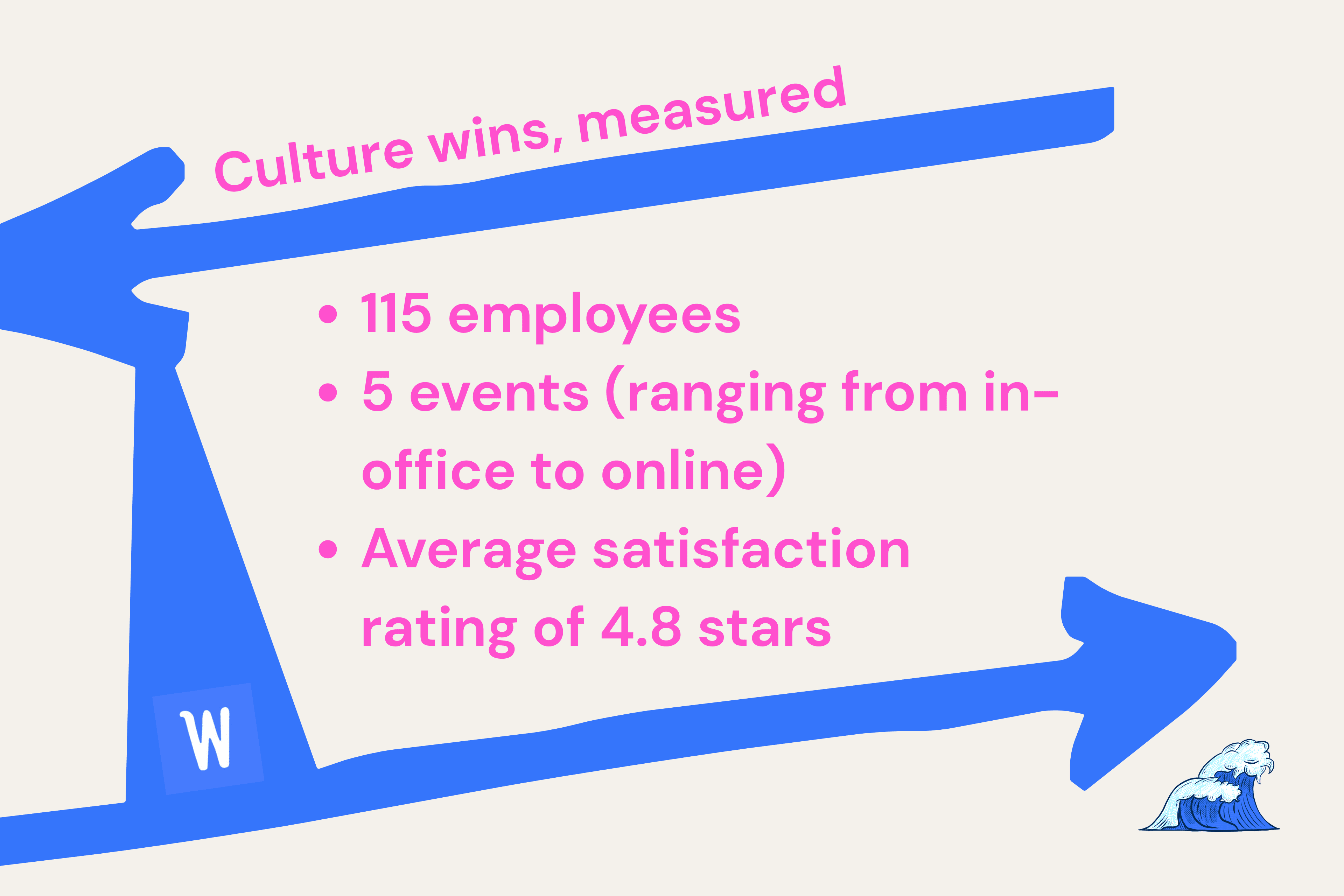
The results? 115 employees participated across 5 events (ranging from in-office to online), with an average satisfaction rating of 4.8 stars.
Async options are still important but…
In the last couple of years, in-person is making its comeback, and people teams are investing in it again. For distributed teams, "in-person" doesn't have to mean flying everyone to HQ. It can mean getting the eight people who happen to live in the same city into a room together.
Local hub programming that include quarterly socials, volunteer days, neighbourhood lunches is one of the highest-impact, lowest-cost moves available to distributed teams right now. These employees might not work directly together. They might be on different teams, in different functions, at different levels. But they share a city, and that's enough to build a real community.
Confluent ran a great version of this at scale. With 3,000+ employees across 30+ countries, they created a Global Experience Ambassadors program. Employees in each region were given a budget and the mandate to host quarterly socials with their local team members. No central coordination required. No waiting for the annual offsite. Just consistent, local, human connection happening across the company simultaneously.
Volunteer days work especially well in this format. They get people out of a conference room, doing something that matters, with colleagues they wouldn't normally spend time with. The shared experience does more for connection than almost any structured icebreaker.
This doesn't replace virtual programming. It sits alongside it.
🌊 Wavy tip: Options = equity. Local in-person moments for community, virtual programming for consistency, and async options for the team members who can't make either. Layer all three and you've covered almost everyone.
5. Build ERGs that actually work for remote employees.
How do you make Employee Resource Groups inclusive?
ERGs and clubs are built around shared identity, background, or interest, not shared location. That means a Pride ERG, a parents' network, a running club, or a book club has a natural reason to exist virtually. The connection is the thing they have in common, not the office they happen to sit in.
Watch: Building Better ERGs with Wavy
Most of these communities already live in Slack or Teams channels. The format is inherently remote-friendly, which means a distributed team has just as much access to this kind of belonging as anyone in a head office.
Coconut Software's DEIB committee runs International Women's Day, Pride Month, and Mental Health Awareness Month programming. All virtually, for 150+ employees spread across Canada. Every initiative is designed so participation is never contingent on being in the Toronto or Saskatoon office. Their Pride Shirt Painting event, fully virtual for the whole company, came in at 97% positive culture impact.
Make these communities visible and give them resources. Give them a budget. Feature them in your all-hands. Create the infrastructure for employees to start new ones easily. You don't need to build ERGs from scratch.
In most companies, the communities already exist informally. Your job is to make them official, give them support, and let them do what they already do naturally: connect people who have something real in common, regardless of where they're working from.
🌊 Wavy tip: Ensure that virtual-first ERG programming has in-person meetups as additions, not the default. Set expectations at the ERG charter level that all programming is accessible remotely.
6. Stop DIY-ing culture at scale.
When should you work with a facilitation partner?
At some point, the internal team runs out of bandwidth and creativity. It happens to every people & culture team eventually. Pretending otherwise just leads to burnout and increasingly mediocre events that people stop showing up to.
If you're Googling vendors, managing logistics manually, chasing RSVPs across three tools, and somehow also supposed to be the energy in the room on the day… you have a second job and we’re not about that.
Jobber's employee experience team manages culture programming for thousands of employees across four offices and beyond. Before consolidating on Wavy, they were running events out of spreadsheets and Eventbrite, with no Slack integration, no consistent feedback collection, and almost no year-over-year data to show for it.
After moving to Wavy: 66 events, 3,776 attendees, a 4.53-star average satisfaction rating, and a dashboard Diana Cobos could actually walk into a leadership meeting with.
Before Wavy, we couldn't prove anything. Now I can walk into a leadership meeting and show engagement by department, spend per event, satisfaction trends. The program went from a cost center to something we can defend and grow. – Diana Cobos, Employee Experience Team, Jobber
They're not alone. Loopio used Wavy to bring in professionally facilitated events their internal team couldn't have produced on their own. A DE&I Fall Harvest Cooking Class with chef Alexandria Bipatnath and a Comedy Show with Second City performers!
The result: These events saw 75% of employees report feeling more connected, with a 93% satisfaction rating.
Remote events are a trial-and-error thing. When you're getting people to log on to their 10th video call of the day, you need to get creative. – Amanda Power, Remote Engagement & Events Manager, Loopio
Both companies ended up partnering with Wavy. Loopio brought in professionally facilitated events (a DE&I Fall Harvest Cooking Class with chef Alexandria Bipatnath, a Comedy Show with Second City performers) that their internal team couldn't have produced alone.
Coconut also ran 20+ experiences across Arts, Wellness, Games, and Food & Drinks categories, saving an estimated 3 hours of admin per event, and landed a 97% positive culture impact score.
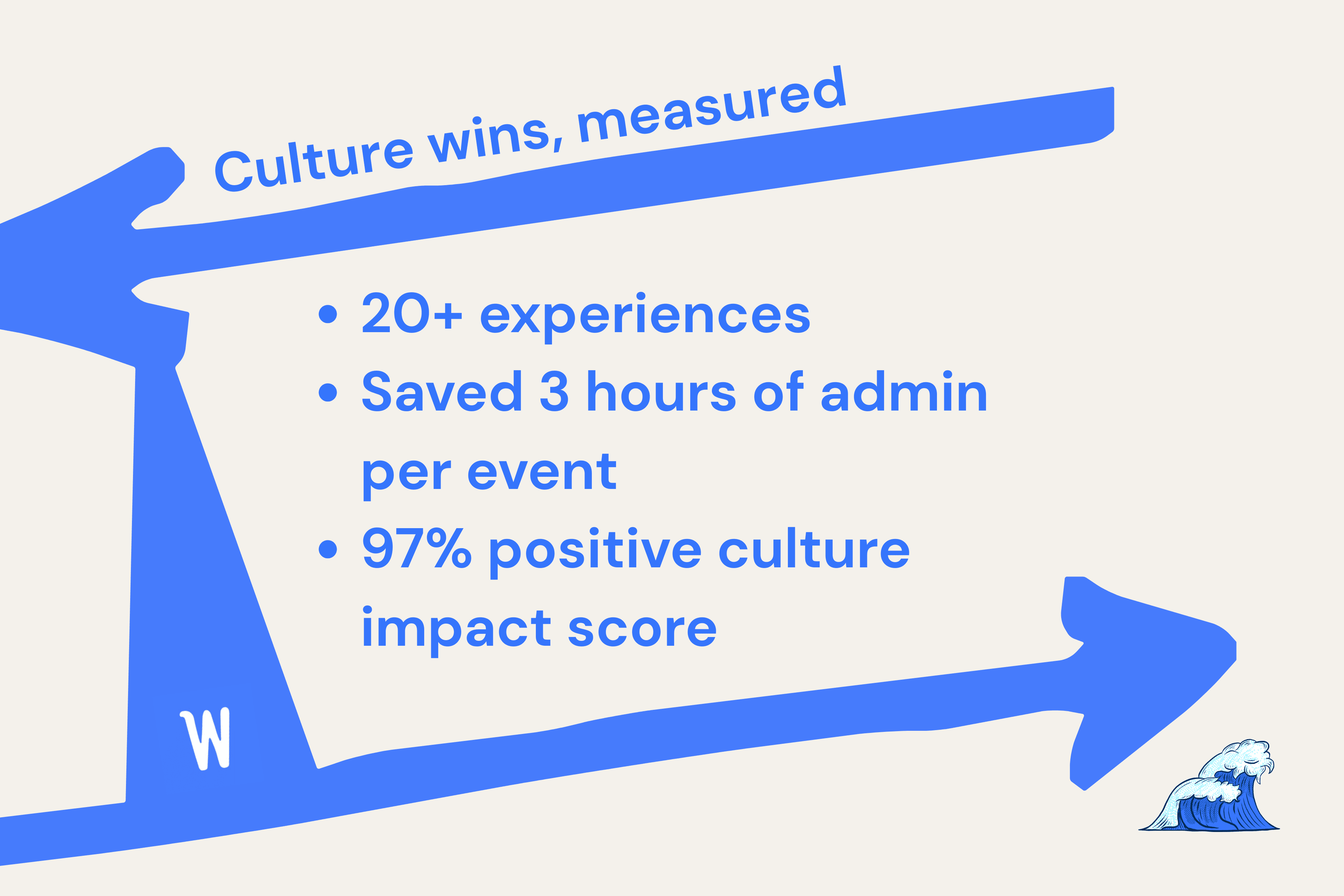
The people teams across all three companies got their time back. The quality of their events also went up and the data finally exists. Finally!
🌊 Wavy tip: External facilitation isn't a shortcut. It's how you scale quality without burning out your people team.
7. Mirror your engagement budget for remote employees.
How do you make hybrid events financially equitable?
If your in-office team gets a catered dinner for the holiday party, your remote employees should get a gift card of equivalent value. Same budget, different format. PostBeyond did exactly this for their first hybrid cocktail class. Everyone received the same experience kit, and those joining online got a gift card to treat themselves to a meal. The feedback from remote attendees: "we felt like we were all together."
That feeling doesn't come from having identical experiences. It comes from knowing the company spent equally on you.
Give your people that psychological safety that they're not missing out on anything when they choose to work from home, because the company means it when they say they encourage and support it. – VP of People & Operations, Shawna Stewart, PostBeyond
🌊 Wavy Tip: Go through your last quarter of culture spend and split it by in-office vs. remote. If those numbers aren't roughly equal, you have your answer for why remote employees feel like an afterthought.
8. Use the hub model for in-person connection.
How do you bring remote employees together without flying everyone to HQ?
All-hands offsites are expensive, logistically painful, and increasingly rare. They're also not the only way to give remote employees an in-person connection.
The hub model: identify clusters of employees in the same city and organize regional gatherings quarterly. Not monthly, quarterly. The goal is connection, not calendar burden. If you’d like to do this more often, you could consider coworking space for local employees to work together!
This approach lets remote employees have the in-person moments that matter (the unstructured dinners, the hallway conversations, the things that don't happen on video) without requiring constant flight bookings and hotels..
It also scales. A hub dinner for 8 people in Vancouver costs a fraction of flying 8 people to New York for an all-hands. And the connection quality is often higher because it's smaller and less choreographed.
9. Onboard new hires remote-first, even if they're in-office.
What are best practices for onboarding new hires in a hybrid workplace?
Onboarding new hires is where inclusive hybrid culture either proves itself or falls apart.
The first week sends a signal that's very hard to unsend. If remote new hires log in on day one to a generic welcome email and a link to an org chart, while in-office new hires get a desk tour, a team lunch, and face time with leadership. Those two employees are already having different experiences of the company.
Build remote-first for everyone, then add in-person layers. Remote-first onboarding means the full experience is accessible without physical presence. In-person moments are bonuses.
Add a human touch before day one. A welcome package, a short Loom video from the team lead, a personal Slack message from a buddy. These are not expensive. A 90-second personal Loom from the hiring manager lands completely differently than a Confluence document with the org chart.
Then build in the in-person moments intentionally. Remote-first doesn't mean never in-person. It means the in-person components are planned. Some formats that work well as follow-on touchpoints:
First regional hub meetup: If the new hire is remote, getting them to the next local hub gathering (quarterly, not monthly, see Tip 8) within their first 90 days makes a significant difference to how quickly they feel embedded.
New hire cohort offsite: Companies onboarding at scale can bring new hire cohorts together in-person as part of their onboarding rhythm. This gives new hires a peer group they actually know before they're dropped into the wider company.
First team offsite or all-hands: Make sure remote new hires are included and introduced in the next in-person company moment.
The goal isn't to recreate the in-office experience for remote employees. It's to make sure their first few months include enough real human moments, virtual and in-person, that they feel connected before the honeymoon period ends.
10. Track participation by location then actually do something about it.
How do you measure inclusive culture?
You cannot fix what you can't see.
Most engagement programs track overall participation, satisfaction scores, and maybe an NPS. Far fewer track whether remote employees are participating at the same rate as in-office employees. Want to go deeper? Do it by department, by seniority, by location.
Jobber uses Wavy's analytics to track engagement across all of those dimensions. That data makes it visible when remote employees in one city are showing up less and gives the team something concrete to investigate, not just a vague feeling that "remote employees seem less engaged."
Before Wavy, Jobber had almost no year-over-year event data at all. No baseline, no benchmarks, no way to prove the program was working. After centralizing their events and planning 66 events for 3,776 attendees in one year, they had engagement trends by department, spend per event, satisfaction trends across event types, and a story they could actually tell in a leadership meeting.
🌊 Wavy Tip: If you’re not using an employee experience solution yet, here’s some things you can do.
Track RSVP and attendance rates by location for every event
Run a quarterly pulse survey with location as a filter
At your next event debrief, ask: "Did remote employees participate at the same rate?
Inclusive culture examples: what does this look like in practice?
Real examples, not theoretical frameworks, include:
Initiative | Format | Who it benefits | Real example |
ERG Virtual Programming | Virtual | Remote employees, underrepresented groups | Coconut Software: IWD, Pride Month, Mental Health Month. 97% positive culture impact |
Wellness Week | Hybrid, choose-your-own | All employees | 7shifts: 5 events across 5 days, 115 participants, 4.8★ avg |
House Teams, Harry Potter style! | Async + virtual | All employees, cross-functional | Loopio: year-long cross-functional teams earn points for engaging across events |
Local Hubs | In-person (regional) | Remote employees in the same city | Bringing remote employees in the same metro together quarterly |
Mirrored event budgets | Virtual | Remote employees | Matching what in-office employees spend at a dinner with an equivalent gift card for those online |
All-company virtual learning labs | Virtual | All employees | Jobber: Zapier Lunch & Learn hit 130% of expected attendance |
Hybrid culinary events | Hybrid | All employees | PostBeyond: same kit shipped to both in-person and remote groups; trivia bridges the two |
Hybrid arts-based events | Virtual | All employees | Coconut Software: fully virtual, 150+ employees, 97% positive culture impact |
The pattern across all of these: equitable investment, not identical experience. Remote and in-office employees don't need to do the exact same thing at the exact same time. They need to feel like they have equal priority.
How does Wavy help hybrid teams build inclusive culture?
Wavy is a Culture OS. A platform that manages the logistics, programming, and measurement of employee programming end to end, built specifically for hybrid and distributed teams.
Here's what that looks like in practice:
The platform handles event communications (Slack + email, in the same thread so it doesn't create noise), RSVPs, Google Calendar integration, feedback forms, and analytics in one place. Jobber's employee experience team runs 66+ events a year for 3,776 attendees across four offices with one dashboard. Before Wavy, that was a mix of spreadsheets,Eventbrite, manual communications, and a mix of polls and survey tools.
The analytics track engagement by department, location, and seniority so you can see if remote employees in Vancouver are participating at the same rate as those in New York, and actually do something about it.
The Marketplace gives People teams access to 400+ facilitated virtual and hybrid experiences such as: cooking classes, trivia, cocktail making, wellness workshops, DE&I programming. All without having to source, vet, or manage vendors. You pick, they run it.
That's the whole game for people leaders right now: making engagement measurable so you can protect the budget and make the case for doing more.
Book a demo to see how Wavy helps hybrid teams build inclusive culture →